
Quick answer
Grayl GeoPress is the industry benchmark — but it's overkill for the European market. It filters viruses (0.004 μm), which you don't need in Europe. It costs €120, lasts only 250 L, and cost per litre is 15× higher than a hollow-fibre bottle. For the Camino, the Alps or European vanlife, 0.2 μm alternatives at €50-60 are a better fit.
Why Grayl is so popular
Grayl GeoPress made its name in the international backpacker community for one real reason: it's one of the few bottles on the market that filters viruses in addition to bacteria. Its gravity-press pushes water through an ultra-fine hollow-fibre cartridge of 0.004 μm combined with activated carbon.
Designed for expeditions to India, Nepal, sub-Saharan Africa or rural South America where water can carry viral contamination (hepatitis A, rotavirus, norovirus). In those scenarios, it's worth every euro.
The problem in Europe
Viral water contamination in the EU is practically non-existent thanks to Directive 98/83/EC on water quality. The problems that actually exist are:
- Bacteria in old or poorly maintained fountains (0.2 μm handles it)
- Chlorine and derivative compounds in municipal taps (activated carbon)
- Sediment from old pipes (0.2 μm)
- Iron or sulphur taste in rural water (activated carbon)
For all of that, a filter of 0.2 μm with a carbon prefilter is enough. Filtering down to 0.004 μm is like using an aircraft fire extinguisher on a cigarette — it works, but you pay 4× the price.
The three numbers that kill Grayl in Europe
Price
€119.95
2× a European 0.2 μm bottle
Filter life
250 L
6× less than a 0.2 μm bottle (1,500 L)
Cost per litre
€0.20/L
15× more than €0.013/L of a European bottle
Honest alternatives ranked by profile
#1 — GoPure (LittlestForest) · €59.99
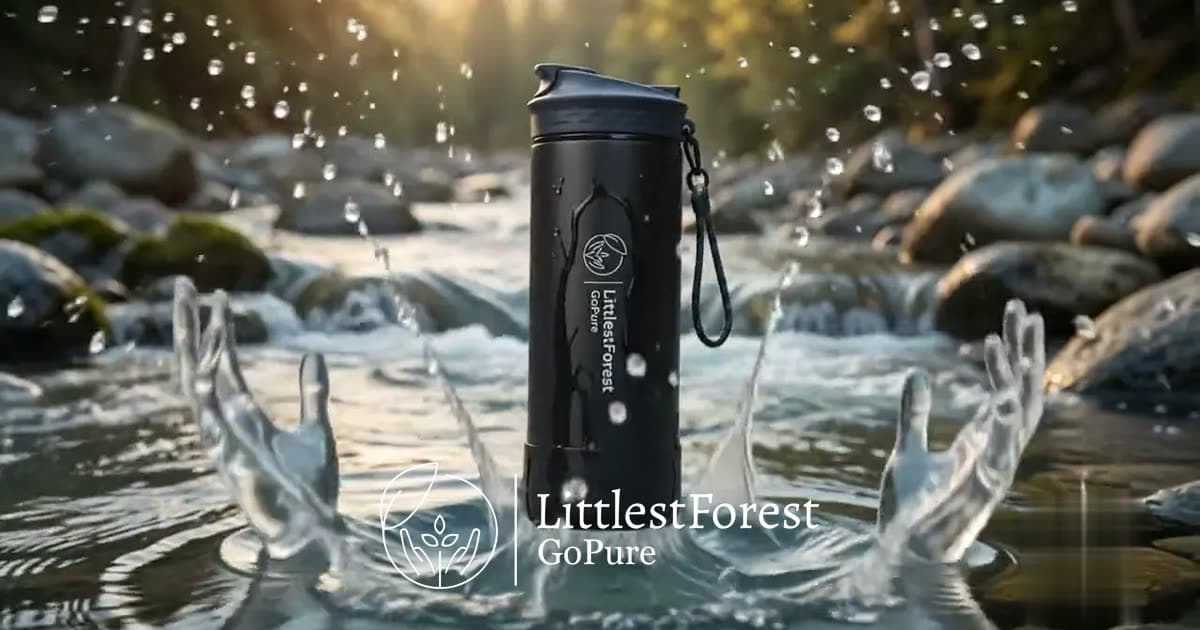
Press-filter bottle 0.2 μm + activated carbon. Designed in Galicia specifically for the European market. 800 ml, 500 g, 1,500 L filter life, cost per litre €0.013. Paracord strap, silicone base, dual opening, BPA-free.
You gain vs Grayl: €60 cheaper, 6× more filter life, better taste.
You lose: doesn't filter viruses (doesn't apply in Europe).
#2 — LifeStraw Go 2.0 · ~€40
The entry-level option. 0.2 μm hollow-fibre membrane. Very popular, good value. Missing carbon prefilter — water tastes exactly as it came from the source (good or bad).
You gain: lowest price, known brand.
You lose: without carbon the chlorine taste stays, bottle without premium details.
#3 — Katadyn BeFree · ~€50
Flexible bag with press-filter. Ultra-light (60 g). Not a rigid bottle — you squeeze the bag. Popular in trail running.
You gain: minimum weight, packs super small.
You lose: not usable as daily bottle (bag creases, can't take drops).
#4 — Grayl UltraPress · ~€90
Smaller, lighter version of GeoPress. 500 ml, 1 L purification by press. Same 0.004 μm filter tech.
You gain: manageable size, same antivirus tech.
You lose: filter life only 300 L, same pricing issue.
#5 — SteriPen Ultra · ~€90
Not a filter but UV purification. A "pen" you dip in water that activates a UV lamp that kills bacteria and viruses. Very effective, but needs previously clear water (sediment blocks it).
You gain: kills viruses, works with any bottle.
You lose: batteries (run out), fragile lamp, useless with sediment.
When Grayl IS worth €120
- You're travelling 3+ weeks in India, Nepal or rural Southeast Asia.
- You work in humanitarian NGO or scientific expedition in zones without potable-water infrastructure.
- You're a professional guide and need to guarantee client safety in any global scenario.
If your scenario isn't one of these three, there are better options for your pocket and for the real use you'll give it.
The honest recommendation
For 95% of pilgrims, European hikers and vanlifers, a filter bottle with 0.2 μm + activated carbon in the €50-60 range is the best decision. GoPure and LifeStraw Go 2.0 cover that range with real value. Grayl is still an excellent product, but for a different use case than the European one.
The best filter bottle is the one you carry when you need it — and at €120 it's easy to leave at home for fear of damaging it. At €60 it becomes your everyday bottle.